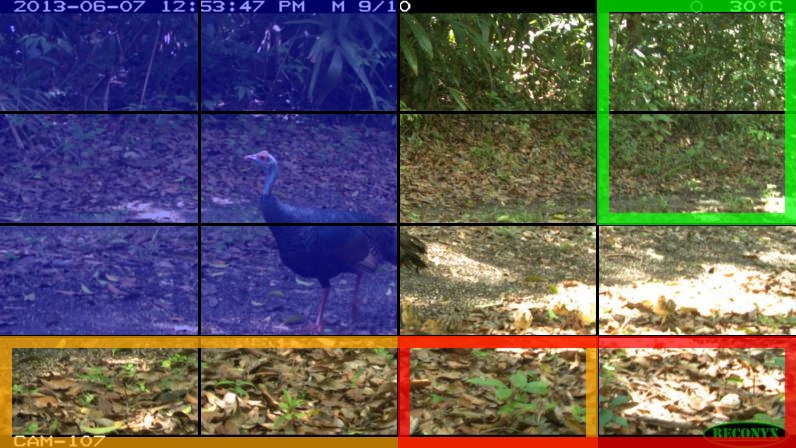
I-JEPA masking on a real iWildCam camera-trap image: the context block (blue) is encoded to predict the representations of several target blocks (green/red/orange).
## Models - ViT-H, 14x14 patches, 224x224 resolution (trained) - ViT-H, 16x16 patches, 448x448 resolution (trained) - Plan: add a graph comparing models with the WILDS leaderboard https://wilds.stanford.edu/leaderboard/#with-unlabeled-data-1 ## Results Linear-probing evaluation on iWildCam2020-WILDS with a **frozen** I-JEPA encoder and a single trained linear head. All values are the mean over 5 seeds (±std). The headline metric is F1-Macro on the Target Out-of-Distribution (OOD) split; the gap Δ = F1(ID) − F1(OOD) measures the drop under distribution shift. Only the ImageNet-pretrained checkpoints are reported here. | Model | ID F1-Macro | OOD F1-Macro | Gap ΔF1 | |---|---|---|---| | ViT-H/14 (224, IN-1K) | 0.338 ±0.015 | 0.214 ±0.006 | 0.124 | | ViT-H/16 (448, IN-1K) | 0.385 ±0.005 | 0.247 ±0.003 | 0.138 | | **ViT-H/14 (224, IN-22K)** | 0.348 ±0.003 | **0.260 ±0.003** | 0.088 | | ViT-g/16 (224, IN-22K) | 0.371 ±0.002 | 0.255 ±0.003 | 0.116 | Key takeaways: - The best frozen probe (**ViT-H/14, IN-22K**) reaches **0.260 OOD F1-Macro**, ranking **#16** on the iWildCam2020-WILDS leaderboard — despite training only a linear head rather than fine-tuning the full backbone. - Its ID→OOD generalization gap (ΔF1 = 0.088) is comparable to the full-fine-tuning CLIP leaders on the leaderboard (FLYP ΔF1 = 0.139, AutoFT ΔF1 = 0.115). - Absolute F1-Macro scales with pretraining data (IN-22K > IN-1K) and input resolution (the higher-resolution ViT-H/16 448 is the strongest IN-1K checkpoint). ### Label efficiency Because I-JEPA pretrains without labels, the representations stay useful when labeled data is scarce. OOD Target F1-Macro when the linear probe trains on 1%, 10%, 50%, and 100% of the labeled Source split (mean over 5 seeds): | Model | 1% | 10% | 50% | 100% | |---|---|---|---|---| | ViT-H/14 (224, IN-22K) | 0.193 ±0.009 | 0.236 ±0.011 | 0.261 ±0.009 | 0.260 ±0.003 | | ViT-g/16 (224, IN-22K) | 0.204 ±0.009 | 0.243 ±0.007 | 0.259 ±0.014 | 0.255 ±0.003 | | ViT-H/14 (224, IN-1K) | 0.120 ±0.036 | 0.190 ±0.010 | 0.220 ±0.012 | 0.214 ±0.006 | | ViT-H/16 (448, IN-1K) | 0.146 ±0.022 | 0.214 ±0.012 | 0.230 ±0.011 | 0.247 ±0.003 | A small labeled subset already recovers most of the full-data performance (diminishing returns), with the IN-22K backbones degrading most gracefully — a practical advantage for wildlife monitoring where labeled camera-trap data is expensive. These results are from the accompanying master thesis evaluating I-JEPA on iWildCam2020-WILDS. ## Repo layout - `src/`: core model, masks, and training utilities - `src/train.py`: SSL training loop - `src/train_supervised.py`: supervised training loop - `configs/`: training configs - `configs/wilds_vith14_ep300.yaml`: SSL config used here - `configs/supervised_vith14_224.yaml`: supervised config used here (see `configs/` for all supervised linear-probe configs) - `main_distributed.py`: entrypoint for distributed SSL training - `main_distributed_supervised.py`: entrypoint for distributed supervised training - `configs/grids/seeds/`: per-model seed grids for multi-seed paper runs - `tools/run_seed_sweep.sh`: launch each model across all seeds (one by one) - `tools/aggregate_seeds.py`: aggregate seed runs into mean +/- std (ID + OOD) - `requirements.txt`: dependencies ## Requirements - Python 3.8+ (compatible and newer) - PyTorch (CUDA 12.1 wheel index): https://download.pytorch.org/whl/cu121 - Key deps: torchvision, submitit, wilds, PyYAML, numpy - Full list: `requirements.txt` ## SLURM commands SSL pretraining: ``` python3 main_distributed.py --fname configs/wilds_vith14_ep300.yaml --folder $submitit_folder --partition $slurm_partition --nodes $nodes --tasks-per-node $tasks_per_node --time $time ``` Supervised fine-tuning: ``` python3 main_distributed_supervised.py --fname configs/supervised_vith14_224.yaml --folder $submitit_folder --partition $slurm_partition --nodes $nodes --tasks-per-node $tasks_per_node --time $time ``` Evaluation on iWildCam test split: ``` python3 main_eval_wilds.py --fname configs/eval_wilds_vith14.yaml --folder $submitit_folder --partition $slurm_partition --nodes $nodes --tasks-per-node $tasks_per_node --time $time ``` Evaluation metrics are written to `experiment_logs/eval-wilds-vith14/iwildcam_test_metrics.json` by default. Variable hints: set `$submitit_folder`, `$slurm_partition`, `$nodes`, `$tasks_per_node`, and `$time` to match your SLURM cluster. ## Multi-seed runs (paper results) To report mean +/- std over seeds, each supervised model is trained across 5 seeds (0-4). Seeding is config-driven via `meta.seed` (applied in `src/train_supervised.py`), and the run folder name includes `-seed{N}` so seeds do not collide. Each run automatically: - evaluates on **both** WILDS splits: `id_test` (ID) and `test` (OOD), so the generalization gap can be measured; - records the WILDS metrics, the wall-clock **training time**, the number of **epochs run** (accounting for early stopping), and the **effective memory usage** into the per-split metrics JSON and into `params.yaml` in the eval folder. Effective memory is captured as a high-water mark during training: - `peak_host_ram_gb`: peak process RSS (`resource.getrusage`), to compare against the SLURM `mem_per_gpu` request (e.g. 180G) and right-size future jobs. With `tasks_per_node: 1` this reflects the whole training worker. - `peak_gpu_alloc_gb` / `peak_gpu_reserved_gb`: peak GPU VRAM (`torch.cuda.max_memory_allocated` / `max_memory_reserved`). The four leaderboard columns are: Test ID Macro F1, Test ID Avg Acc, Test OOD Macro F1, Test OOD Avg Acc (headline metric: `F1-macro_all`). Launch all models, one at a time, each across all seeds (SLURM/submitit): ``` bash tools/run_seed_sweep.sh --partition $slurm_partition --time $time ``` Run a subset of models: ``` bash tools/run_seed_sweep.sh --partition $slurm_partition --models "vith14_224 vith16_448" ``` Per-model seed grids live in `configs/grids/seeds/` (each sets `meta.seed: [0, 1, 2, 3, 4]` over the corresponding `configs/supervised_*.yaml` base config). They are launched via `tools/run_grid.py`. Aggregate mean +/- std across seeds after the jobs finish: ``` python3 tools/aggregate_seeds.py --root experiment_logs/eval-wilds ``` Outputs: - `experiment_logs/seed-runs/